It is interesting, to me, how much of the perspective of this film is built around street harassment, the trope of stranger rape, and then institutionalized sexism.
Monday, February 10, 2014

Friday, October 18, 2013
Activist Librarians and Public Space
I love librarians. I really love librarians who use jobs to intervene in destructive social practices.
The 'teen' space in our downtown library is often out of control. I go in there regularly to fetch books for my kids (I love picking out books!) and am continually amazed at the interactions I witness. They verbally and physically push each other around. I've picked a boy up off the floor after a scuffle. I've heard bragging over non-consensual sexual conquests. "Nigger" is bandied about without bravado as these kids claim their space and drive others away while the librarians cower behind their desk on the "kids" side of the basement.
My kids were horrified when I asked the librarians what expectations had been set for the space. To them, this was just another example of an adult undermining the social life of non-adults. To me, however, I was thinking that we should talk about how the teens could use the space without driving others away or imposing their use on the whole base level of the library.
The 'teen' space in our downtown library is often out of control. I go in there regularly to fetch books for my kids (I love picking out books!) and am continually amazed at the interactions I witness. They verbally and physically push each other around. I've picked a boy up off the floor after a scuffle. I've heard bragging over non-consensual sexual conquests. "Nigger" is bandied about without bravado as these kids claim their space and drive others away while the librarians cower behind their desk on the "kids" side of the basement.
My kids were horrified when I asked the librarians what expectations had been set for the space. To them, this was just another example of an adult undermining the social life of non-adults. To me, however, I was thinking that we should talk about how the teens could use the space without driving others away or imposing their use on the whole base level of the library.
Tuesday, September 17, 2013
Mainstreaming Women in Urban Design
How to Design a City for Women, Sept 16, 2013
You'd think I'd cheer to see an article like this about an initiative about this, but its overly reductionist use of "women" and the underlying assumptions that what women need is "different" and "special" make my skin crawl. I'm not sure that the kind of dichtomizing going on here is useful in the long run and will likely undermine the "mainstreaming" project.
You'd think I'd cheer to see an article like this about an initiative about this, but its overly reductionist use of "women" and the underlying assumptions that what women need is "different" and "special" make my skin crawl. I'm not sure that the kind of dichtomizing going on here is useful in the long run and will likely undermine the "mainstreaming" project.
Monday, May 6, 2013
Single-Sex Subway Experiments

A "ladies only" New York subway car, circa 1909 -- this experiment was quickly abandoned.
Saturday, March 9, 2013
Feminism.... It's Not Just for Women Anymore!
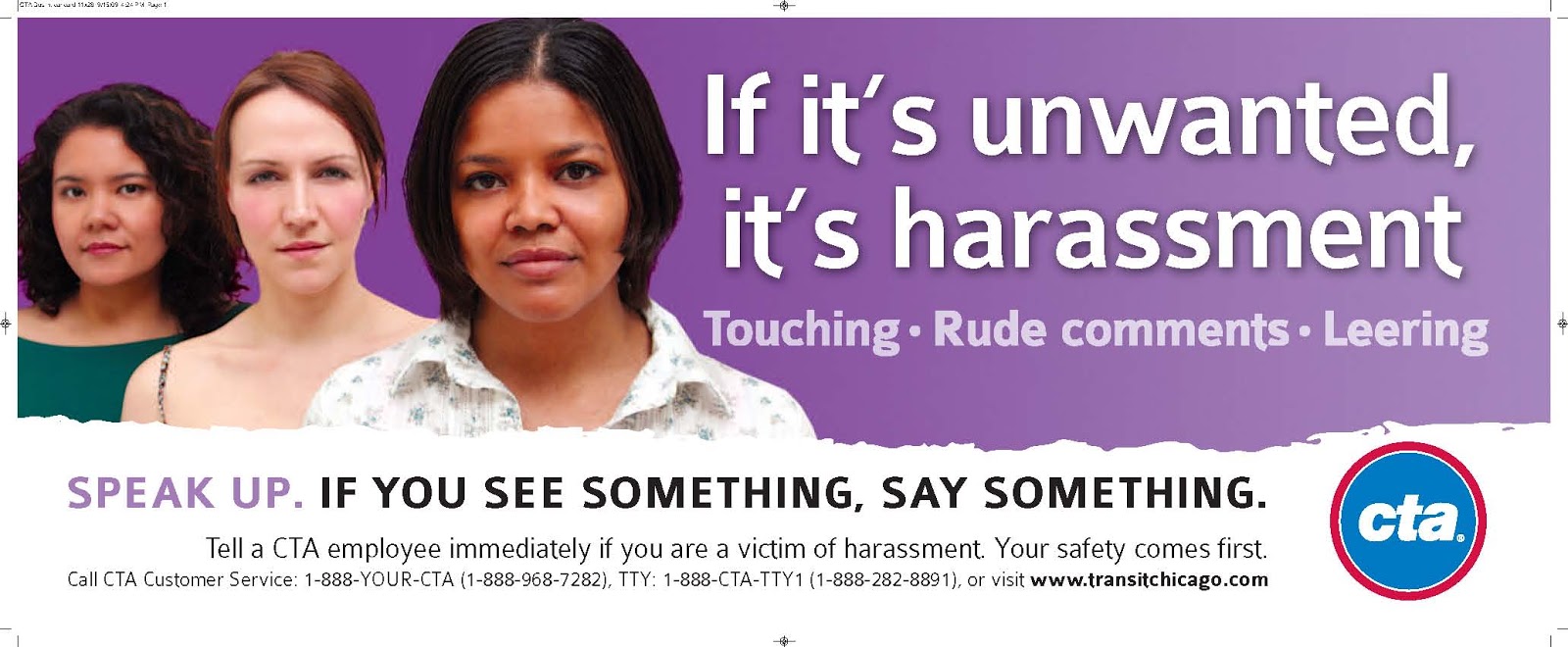
One interesting outcome of feminist activists demanding better anti-harassment measures by public transit companies in the last couple of years is the 'discovery' that these policies and laws stand to benefit more than just women.
While this feature article from the Chicago Tribune is expressing a frustration that it hasn't gone far enough, the author is framing his call to action around panhandling on the Chicago Transit Authority's anti-harassment campaign launched in 2009. He notes, "The public relations effort amounted mostly to informational placards on buses and trains telling transit customers to report behavior that is physical or threatening" and then he challenges his readers to do just that to report panhandlers to CTA officials and Chicago police, if necessary.
The CTA's anti-harassment campaign, then becomes a tool for challenging disturbing behavior of many sorts, not just gender-based harassment.
 Of course, as this comment left on a NYT article makes apparent, this approach can go too far...
While this feature article from the Chicago Tribune is expressing a frustration that it hasn't gone far enough, the author is framing his call to action around panhandling on the Chicago Transit Authority's anti-harassment campaign launched in 2009. He notes, "The public relations effort amounted mostly to informational placards on buses and trains telling transit customers to report behavior that is physical or threatening" and then he challenges his readers to do just that to report panhandlers to CTA officials and Chicago police, if necessary.
The CTA's anti-harassment campaign, then becomes a tool for challenging disturbing behavior of many sorts, not just gender-based harassment.
Thursday, February 28, 2013
Pink Taxis
Another recent effort at "women-only" spaces/services...
What do you think...would you go for the pink taxi if you could?

What do you think...would you go for the pink taxi if you could?
Friday, February 22, 2013
Thursday, February 21, 2013

Friday, February 15, 2013
Ideology Isn't as Much Fun as Street Theater, Apparently
Gems from the Lesbian Avengers from the mid-1990s:
"[D]o radical outrageous stuff."
"[W]orking out an ideology is fruitless and exhausting."
“It is a waste of time, not to mention emotional energy, to try and argue everyone into consensus; what inevitably happens is that some people--usually those without resources and/or confidence--simply give up and others end up determining the strategy.”

"[D]o radical outrageous stuff."
"[W]orking out an ideology is fruitless and exhausting."
“It is a waste of time, not to mention emotional energy, to try and argue everyone into consensus; what inevitably happens is that some people--usually those without resources and/or confidence--simply give up and others end up determining the strategy.”

We Want:
More space.
Economic Equality.
Women to stop taking
shit.
Men to stop giving us shit.
Tuesday, November 13, 2012
Women-only Parking Spaces
So... this European and Asian phenomenon is making its way to North America. My disappointment is great. At best, these efforts write women onto public space as vulnerable entities in need of protection and special services that 'regular' people don't need.

At worst, they are a vehicle for ridicule.


At worst, they are a vehicle for ridicule.

 |
Thursday, September 6, 2012
New Converts to the Bathroom Project
My urban history students got quite lively in their discussion of public bathrooms today. I think I'll treat them to a new pic of an unusual public bathroom every week. Hmmm... what to start with????
 "Chinese visit a four-story, free-of-charge public restroom in Chongqing,
China Saturday July 7, 2007. They're flushing with pride in a
southwestern Chinese city where a recently opened porcelain palace
features an Egyptian facade, soothing music and more than 1,000 toilets
spread out over 3,000 square meters (32,290 square feet). Officials in
Chongqing are preparing to submit an application to Guinness World
Records to have the public restroom listed as the world's largest,
state-run China Central Television reported Friday. (AP Photo) ** CHINA
OUT **"
"Chinese visit a four-story, free-of-charge public restroom in Chongqing,
China Saturday July 7, 2007. They're flushing with pride in a
southwestern Chinese city where a recently opened porcelain palace
features an Egyptian facade, soothing music and more than 1,000 toilets
spread out over 3,000 square meters (32,290 square feet). Officials in
Chongqing are preparing to submit an application to Guinness World
Records to have the public restroom listed as the world's largest,
state-run China Central Television reported Friday. (AP Photo) ** CHINA
OUT **"

Tuesday, August 21, 2012
CUPID
I ran across a reference to an organization called Citizens for Upgrading Prostitution in Detroit (CUPID) in a 1980 article from The Observer on the Women's Movement in the US. Hunh. Anybody know anything about them? Well, I'll start asking around...
Young Woman Goes to the City (1970s-style)
"Dear Mom & Dad,
Have gone to Chicato to seek fame and fortune. Don't wait up.
-Love, T.R."
Have gone to Chicato to seek fame and fortune. Don't wait up.
-Love, T.R."
 |
| T.R. Baskin, 1971 |
I need to track down a copy of this film! I remember seeing it once before, long, long ago and long before this research project existed. I think it will help with my chapter on the 1970s and it can't possibly be worse than "Looking for Mr. Goodbar" or "An Unmarried Woman."
Thursday, August 9, 2012
Street Harassment in Belgium
Ms. seems to have street harassment on their radar of late. Here is an article on a short film that is reminiscent of Hadleigh-West's War Zone.
Tuesday, August 7, 2012
Personal Space and Beach Volleyball
A recent article in The Atlantic raises many key points in just a few short paragraphs. Not surprisingly, the author darts between culture, law, custom, and activism leaving them all underexplored.
 "The perception of women’s bodies as public property to be commented upon
and regulated is one of the universal undercurrents of urban life, no
matter what we are wearing. Covered or uncovered, women are targets for
judgment, appraisal, and harassment."
"The perception of women’s bodies as public property to be commented upon
and regulated is one of the universal undercurrents of urban life, no
matter what we are wearing. Covered or uncovered, women are targets for
judgment, appraisal, and harassment."
I particularly appreciated that the article offered a critique of "women-only spaces" by quoting a woman from Delhi: "Segregating men and women will never help anyone develop tolerance and respect for others’ PERSONAL SPACE."

I particularly appreciated that the article offered a critique of "women-only spaces" by quoting a woman from Delhi: "Segregating men and women will never help anyone develop tolerance and respect for others’ PERSONAL SPACE."
Friday, May 11, 2012
Public Drinking Cultures across Time and Space
Here is a fun new project to follow: public drinking!
http://tavernsproject.com/
Five historians are blogging about their research in different eras and locations. The project "looks at how public space is used, and how tavern culture produces places and social groupings; how these spaces are regulated in the name of order, morality and health; the rhetorics of drinking and taverns, of pleasure, harm and authority. The project asks if the performance of drinking, and ideas of spectacle and carnival, are still part of modern drinking culture, and if contemporary questions about public policy on drinking and ‘anti-social behaviour’ find resonances in the past."
Salud!
http://tavernsproject.com/
Five historians are blogging about their research in different eras and locations. The project "looks at how public space is used, and how tavern culture produces places and social groupings; how these spaces are regulated in the name of order, morality and health; the rhetorics of drinking and taverns, of pleasure, harm and authority. The project asks if the performance of drinking, and ideas of spectacle and carnival, are still part of modern drinking culture, and if contemporary questions about public policy on drinking and ‘anti-social behaviour’ find resonances in the past."
Salud!
Saturday, December 24, 2011
Yeah, right...

Speaking of women's workplace experiences packaged up for puffy entertainment... I've been struck lately by the wallowing in pre-feminism workplace gender roles that seems to be at the heart of both Mad Men and Pan Am.
By setting these shows in the early 1960s, we can slap women on the ass, stuff their perfect bodies into girdles, call them girl, have them make coffee, clean up after us, and manuever them into a lunchtime tryst all under the guise of "look how far we've come." But the nostalgia of this... the way in which the shows revel in it: "Can you believe how bad it used to be?" wink, wink, nudge, nudge.
A Visit to TVland

A few months back I watched Bosom Buddies. I see some television producers at ABC have also been revisiting the vault and will be offering up a new version soon. I'm not much of a TV watcher, but this promo pic and the trailer on the website are low-hanging fruit. Hey, kids, let's make a joke out of the challenges women face in the workforce... sounds awesome. I can hardly wait...
Wednesday, December 14, 2011
Gender Gaps in the "Revolution"
I came across this letter to Slog today and wanted to share/remember it. The statistics she cite, about the "serve passenger" trips that women are far more likely to make than men has long troubled me when we talk about all sorts of movements that are embraced in progressive circles: bicycling, community gardening, permaculture, greening, and locavore-ism. I continue to believe that we have to talk more about where people go -- how, where, why, and with whom they travel -- and what they do within their households. If we don't, pleas to eat more fresh, local produce or ride your bike become unfunded mandates, the burden of which falls disporportionately to women -- the people who, in most multi-person households, still do the bulk of the shopping, food preparation, housework, and childcare.
So, here's the most relevant part of the letter:
"In the United States, about 23% of all cyclists are women (which is based on Census data about commutes). In fact, the number of women who commute by bicycle has decreased from from 33% of all bike trips in 2001 to 24% in 2009 (this is from the American Community Survey, which is conducted by the Census Bureau). For comparison, 55% of all bicycle trips in the Netherlands is by women, and 49% in Germany.
The above data about the US is especially striking if you consider that bike trips are up significantly during the same period of time (2001 to 2009), which indicates that many more men are taking to the streets by bike but women are not.
There's something different about the United States. And it's infrastructure. Studies across all sorts of disciplines show that women are more risk-averse, and indeed, concerns about riding in traffic are overwhelmingly the reason women cite for not riding their bikes. Women also have different travel patterns: they perform the vast majority (77%) of all "serve passenger" trips (hauling people, usually children, around), engage in more "trip chaining," and run more errands, like grocery shopping. They also drive fewer miles to their commutes (this is all based on the 2009 National Household Transportation Survey).
And where have we invested in segregated bicycle lanes? Along recreational corridors, that don't lead to schools, daycare centers, grocery stores, or major employment centers. In other words, the safest bicycle facilities have been installed where few women really want or need to go."
So, here's the most relevant part of the letter:
"In the United States, about 23% of all cyclists are women (which is based on Census data about commutes). In fact, the number of women who commute by bicycle has decreased from from 33% of all bike trips in 2001 to 24% in 2009 (this is from the American Community Survey, which is conducted by the Census Bureau). For comparison, 55% of all bicycle trips in the Netherlands is by women, and 49% in Germany.
The above data about the US is especially striking if you consider that bike trips are up significantly during the same period of time (2001 to 2009), which indicates that many more men are taking to the streets by bike but women are not.
There's something different about the United States. And it's infrastructure. Studies across all sorts of disciplines show that women are more risk-averse, and indeed, concerns about riding in traffic are overwhelmingly the reason women cite for not riding their bikes. Women also have different travel patterns: they perform the vast majority (77%) of all "serve passenger" trips (hauling people, usually children, around), engage in more "trip chaining," and run more errands, like grocery shopping. They also drive fewer miles to their commutes (this is all based on the 2009 National Household Transportation Survey).
And where have we invested in segregated bicycle lanes? Along recreational corridors, that don't lead to schools, daycare centers, grocery stores, or major employment centers. In other words, the safest bicycle facilities have been installed where few women really want or need to go."
Thursday, April 7, 2011
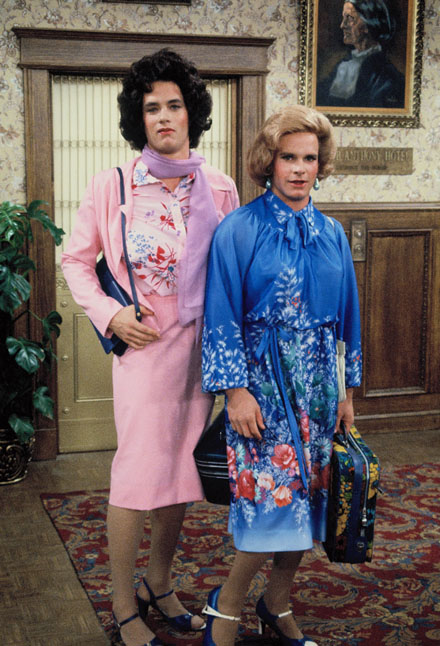
 So... do you remember the sitcom Bosom Buddies? It was a buddy comedy from 1980s starring (a shockingly young) Tom Hanks and Peter Scolari. Desperate to find a cheap place to live, the two men turn to drag in order to secure a room in a women's only NYC residence, the fictional Susan B. Anthony. As I ponder the part of my book dealing with such institutions, I think I need to re-watch the two seasons of this show to get a sense of the 1980 image of such women's-only residences.... I bet there are also some tasty helpings of heteronormativity slathered all over these episodes... What else will I find?
Subscribe to:
Posts (Atom)
The last thread, available by link, was unbelievable in that regard. There’s a difference between the fear, humiliation and self-loathing that can be brought on by sexual aggression and being irritated by a musician or having near a person with dirty clothes. If you’re the sort of jerk who wants to enforce your perfectly harmonious environment on everyone around you, please, get a car and act like that jerk inside it. The subways are public, and that ought to include a little freedom of expression, not to mention a little tolerance for those who have no where else to go, or no other way to get there.
People don’t keep their life’s possessions in shopping bags in order to offend you. They do it because they don’t have your nice apartment. Deal.
— Jordan